




The power of search engines in the digital age cannot be overstated.
For older generations, it may be easy to overlook the necessity to work on the digital side of your business…
…but for the younger generation, there has never been a world where you can’t use Google to search for everything you might want to buy.
In fact, the number of people utilizing search engines grows steadily year after year.
Sure, not all of those searches are related to eCommerce.
However, research notes that 43% of all eCommerce traffic comes from organic Google searches (Wolfgang Digital, 2017).
That’s a significant enough amount to start taking your search engine optimization strategy seriously.
The solution to getting ahead in the internet-searching age is to optimize your web page so that search engines can more easily find you.
This process, called search engine optimization, or SEO, involves a lot of time, effort, and research to be effective.
However, when effective, having a web page that ranks on the first page of Google, or any other search engine, often helps businesses grow tremendously.
For this reason, SEO has become a hugely popular part of the marketing industry.
Even if you don’t know much about search engine optimization, it is easy to learn the basics online.
We’ve even published articles that can give you a better idea of the importance of things like organic SEO and local search engine marketing.
However, when it comes to your SEO strategy, it doesn’t get any more basic than keyword research for SEO.
This is the very first place you start when working on your SEO strategy.
- Without a good foundation of well-researched keywords, all of the time and effort you put into your SEO could be futile.
- While long-tail keywords still have high competition, the idea is that they are more refined, and therefore more likely to capture a sale.
- People know what they want, and you can show up in front of them, right when they want it.
Why is Keyword Research for SEO Important?
Google receives over 63,000 searches per second on any given day (InternetLiveStats, 2019).
This means that at any given time in the day, someone, somewhere, could be searching for the good or service that your business provides.
Let’s look at it this way – ranking near the top of a search engine results page (or SERP) is more tailored and more personalized than a billboard or a magazine ad could ever be.
That’s the reason why Google advertisements are so popular and effective – people know what they want, and you can show up in front of them, right when they want it.
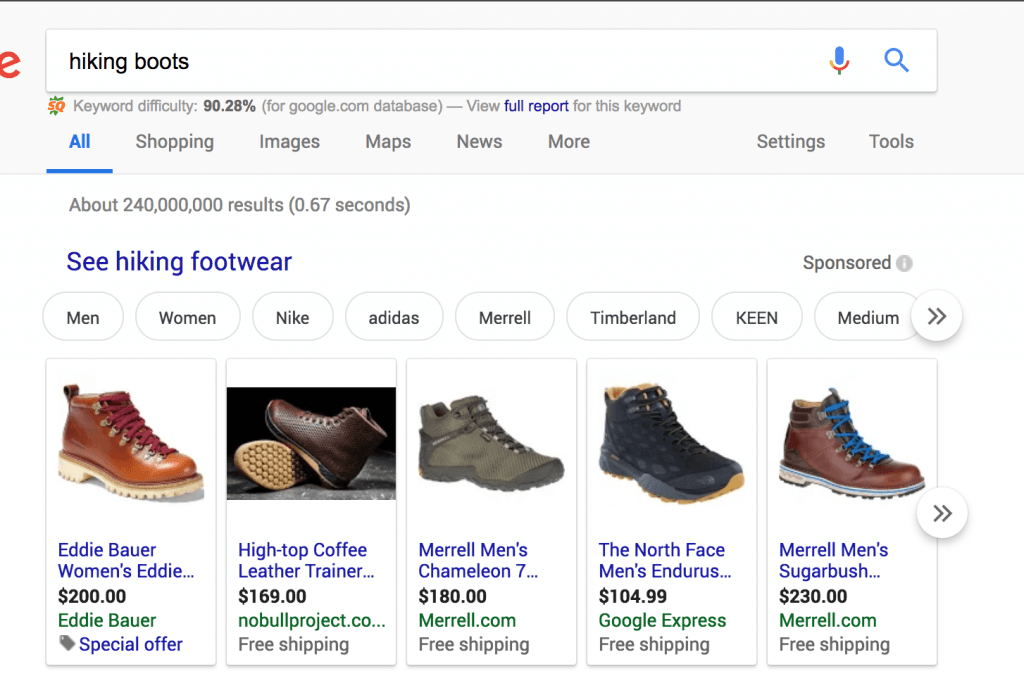
You may think you can skip the keyword research for SEO, but that could lead you to waste your time optimizing your site for a keyword you won’t likely ever rank for.
It could even lead you to waste your time trying to rank for a keyword that doesn’t actually fit your business.
Keyword research for SEO lays the foundation for the rest of your SEO practices.
Without a good foundation of well-researched keywords, all of the time and effort you put into your SEO could be futile.
If you’re still not convinced, and you have a physical store, just know that 34% of consumers visit a store within a day of their local search on a computer or tablet (Google, 2016).
Having a good SEO strategy in place by doing thorough keyword research for SEO can grow your business online and off.
Understanding the importance of keyword research for SEO will become more apparent when you understand what a keyword is, and the different types of keywords there are.
What is a keyword?
A keyword is essentially a word or phrase that people type into a search bar on a search engine.
Different keywords, even if they are for similar things, can have different competition and popularity.
The amount of monthly average searches for one might be much higher or lower than for another that is almost identical.
Likewise, two keywords can have very different levels of competition to rank for them.
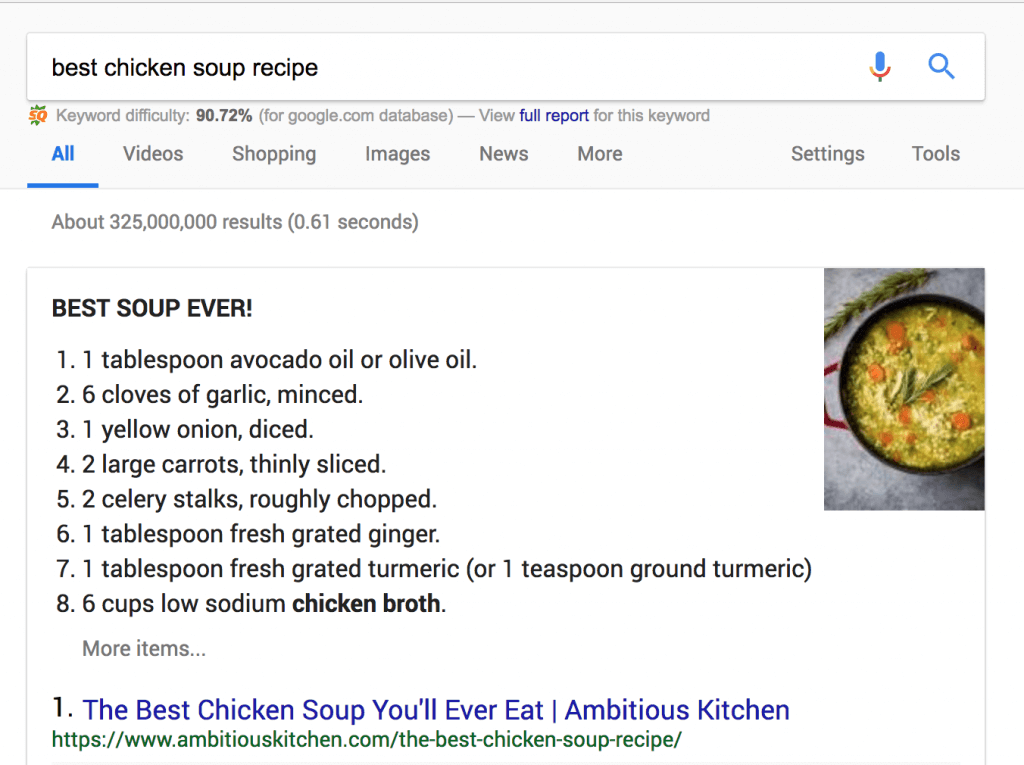
If you type “best chicken soup recipe” into Google, you will see a featured snippet highlighting the top result for this keyword, followed by recipe after recipe for chicken soup.
But, if you just type “chicken soup” into Google, you will see a different set of recipes, as well as results for the “Chicken Soup for the Soul” franchise.
Both of these are examples of keywords, and although they seem similar, they can lead to very different results.
So, why is it important to take note of the different results for seemingly related keywords?
Understanding that each keyword has a different level of competition will help you understand where your website can fit in…
…and how it can compete in this over-saturated marketplace of search results.
The different types of keywords – long-tail and short-tail
When people type search phrases into a search engine, there are two types of searches they could be performing – a more generalized search…
…either to research what they want to buy, or because they don’t need to be very specific, or a more specific, specialized search.
When someone is doing a more general search, there is a stronger likelihood that may be doing some initial research on what they want to buy.
This is a great opportunity to show up on a top position in a SERP because you can help pull a potential lead in your direction.
However, there is often more competition when trying to rank for these general terms, which are also called short-tail keywords.
They are short-tail because these keywords often have 3 words or less.
When someone knows exactly what they want to purchase, they are more likely to type in a longer, more specific phrase into a search engine.
Essentially, long-tail keywords are ones that use 3 to 5 words. These are often more specific, so there are fewer monthly average searches for these keywords.
However, if they apply to your business, these could be very valuable to optimize your website for…
…since whoever is using these long-tail keywords knows exactly what they are looking to purchase.
For example, if you search “golf balls” into Google, millions of results come up.
Some are for cheap wholesale golf balls, some are for used golf balls, and some are for personalized balls.
It’s hard to know exactly what the person who searches for “golf balls” is looking for, other than golf balls, of course.
If you know that you are looking to print your logo on golf balls to give away at a convention, you would search something like “custom logo golf balls” or “personalized golf balls.”
While these particular long-tail keywords still have high competition, the idea is that they are more refined, and therefore more likely to capture a sale.
Additionally, long-tail keywords are often easier to rank for than short-tail.


As you can see, the amount of results for the long-tail keyword shrinks by more than 100 million.
Enter voice search queries
Here’s an interesting data:
Did you know that based on a PWC report, 71% of people prefer using voice assistants to the usual typing when they are searching for something on the internet?
And what’s more important is the fact that spoken and typed queries show different search results.
So if your competitor’s website content is more voice search optimized than yours, then you will fall behind the competition.
The main difference of voice search keywords compared to typed keywords is that when we use voice assistant, we often talk to it as if we are talking to an actual human.
It sounds more natural. Most people would say “Hey, Siri…” or “Okay so Google…” and such. So, voice search queries are often questions using natural language.
Important Steps in Keyword Research for SEO
When beginning your keyword research for SEO, it is important to know the first steps one must take to have a better understanding of keyword opportunities and competition.
Each of these steps has a potential to give valuable insight on the eligibility of a keyword to work for your SEO plan.
1. Brainstorm Potential Keywords
Creating a list of potential keywords that apply to your business is a helpful first step.
This list will give you somewhere to go, and this process will give you a better idea of what others may be searching for when looking for a business similar to yours.
Simply start brainstorming – this list does not need to be perfect or fully fleshed out just yet. Again, this is just a starting point to help you with the next step.
2. Research Average Monthly Searches
This step can be a little tricky if you don’t have a tool to help you find the number of searches a keyword gets per month.
There are several different places you can go to find a tool such as this – some of them are free, and some of them are not.
If you have a Google Ads account, utilizing the keyword research tool will give you the average monthly searches, as well as information useful for creating pay per click ads.
Even information on pay per click costs will help you get a better idea of which keywords are popular and which are not.
While you may want to immediately go after the keywords with the highest average monthly search volume, you’re not done with your research just yet.
High search volumes are only helpful if you know the keyword is relevant, and if you can compete with the rest of the pages that rank for that keyword.

This example of keyword search volume goes to show that even similar keywords can have varying levels of popularity.
3. Research Keyword Difficulty
Another factor in understanding what keywords are best to go after is the keyword difficulty score.
This is a number from 1 to 100 that gives you an idea of the difficulty you will have in ranking for that particular keyword.
The lower the keyword difficulty, the less difficult it is to rank, and the higher, the more difficult.
This score was developed by SEO experts to give people a quick, simple way to gauge the possibility of ranking on a SERP.
Again, if you don’t have a tool to help you find the keyword difficulty of each of your keywords, this step will be a little tricky.
Most tools for both keyword monthly searches and keyword difficulty can get quite costly…
…so it may be best to consider a professional digital marketing agency for your keyword research for SEO.
There are several tools that will soon become your friend.
Using an incognito browsing window to look into the competition for different keywords will ensure that any cookies from your browsing history won’t interfere with the results of your research.
However, an incognito window will not prevent results from being localized.

4. Research the Competition
Lastly, take a look at the other websites that rank for the keyword you want to go for. Are they using the keyword in their page text or HTML? Are they very popular sites?
Understanding the different factors that go into a website’s search engine ranking will help you gauge the competition a little better.
Utilizing a tool that will tell you the domain authority and page authority of a web page is very helpful.
Domain authority and page authority are some of the factors that go into a website’s search engine ranking. DA and PA are determined by a number from 1 to 100.
And the higher the number, the more power a website has to rank in a high position.
While these aren’t the only factors to a good SEO plan, DA and PA also help you gather the popularity and reach of a website.
The more reputable sites link to a page on a website, the higher their DA and PA will go.
Making sure you can compete with others on a SERP is an important step to your keyword research for SEO.
Final Thoughts
Hopefully, this article was helpful and will supplement your understanding of keyword research for SEO.
Even knowing the basics of SEO can be beneficial – it can help give you a better idea of what to look for…
…if you decide to get a professional digital marketing agency to give you a hand in boosting your website rankings.
Oftentimes, it pays to hire professionals that will save you the time and effort in learning SEO on your own;
…but knowing the basic process they go through will give you a leg up in interpreting their SEO recommendations.
Additionally, even just knowing the basics of SEO can give you a better perspective on how your website stacks up against the competition.
This is valuable information that you can and should take back to your marketing team in order to aid in your marketing strategy.
In some cases, it may not even be a pressing necessity to invest in an SEO plan.
However, a business that understands the best channels to utilize for their marketing efforts – whether it’s print, digital, or social…
…is always going to be light-years ahead of the business that does not take the time or effort to put in thoughtful research.
See something we missed in the keyword research process? Let us know in the comments.
LYFE Marketing can help you make sure your site is perfectly optimized with thorough SEO keyword research. Contact us today!

