



An effective digital marketing strategy can help your online business connect with its target audience to generate leads and convert them into paying customers. For B2B online marketing companies, it helps build relationships, show expertise, and prove that your products or services solve key problems.
What Is Digital Marketing?
Businesses relied on billboards, TV ads, direct mail, and store displays before online advertising. But now people spend more time online, there is a shift in marketing.
You can now reach your customers through online advertising platforms like social media, search engines, websites, and email. This is digital marketing.
Why You Need Digital Marketing
The traditional marketing channels still hold their importance, but if you’re not using different types of online advertising, you’re missing out on what digital marketing has to offer.
Here are some advantages of digital marketing:
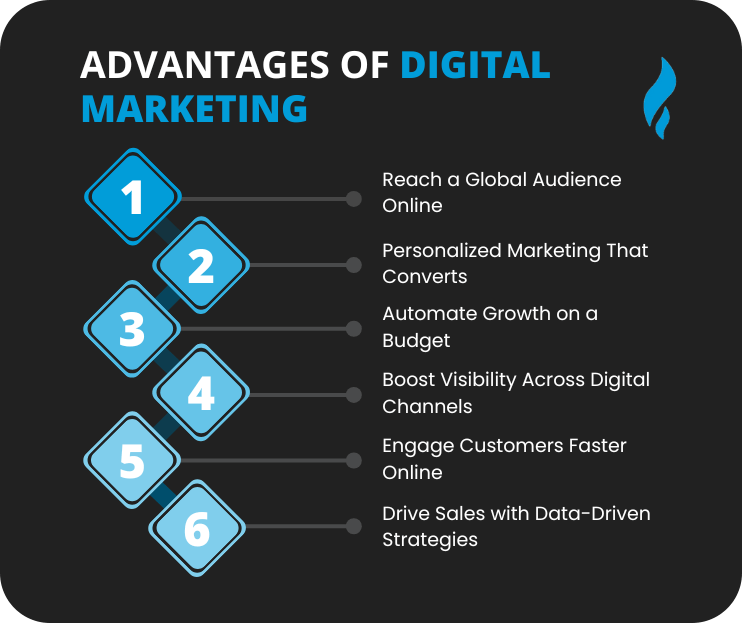
- You can reach a global audience with online business marketing.
- Digital marketing can be used to segment your audience and send personalized messages, which are more effective.
- You can get more online customers using automation, even with a smaller marketing team and a limited budget.
- Your business can get more visibility through different types of online marketing and digital channels.
- Digital marketing helps your business communicate faster with your customers.
- Online marketing data can help your business make data-driven digital marketing strategies to increase online sales.
Types Of Digital Marketing
To compete and grow online, you need a strong digital marketing strategy. This means using multiple digital channels. G2 reports that marketing campaigns using three or more channels get 250% more engagement and purchases than those using only one.
Your digital marketing strategy should include channels like email marketing, Google Ads, content, affiliate marketing, SEO, paid ads, influencer marketing, social media, and conversion rate optimization.
What Is A Digital Marketing Strategy?
A digital marketing strategy is an integrative plan of how your business will use social media, search engines, emails, and content. It sets clear goals and pinpoints your audience.
Your digital marketing strategy should answer these fundamental questions:
- What does your business want to achieve?
- Why does it matter for your business?
The strategy is your foundation, but its success depends on your tactics and digital marketing campaigns. Let’s break down what they are:
- Strategy: Your main marketing goals based on your needs.
- Campaigns: Short-term efforts to hit marketing goals.
- Tactics: Specific actions within campaigns, like posting on social media or launching a paid ad.
This division will guide your marketing strategy toward your business goals.
How Does Marketing Strategy Differ From Campaigns Or Tactics?
To stay clear and organized, you need to separate your strategy from the campaigns and tactics that support it.
| Aspect | Strategy | Campaigns | Tactics |
|---|---|---|---|
| Definition | Long-term plan that supports your business goals | Targeted effort to achieve a specific goal | Specific actions within campaigns |
| Focus | Broad and covers multiple areas | Focused on a single objective | Narrow and task-specific. |
| Duration | Long-term (months to years). | Medium-term (weeks to months) | Short-term or immediate |
How They Work Together
- Again, your strategy is a long-term marketing vision or goal. An example is increasing your sales by 25% in 6 months.
- Campaigns put your strategy into action, like sending an email campaign to engage potential customers.
- Tactics are a further smaller step you take within your campaign, like writing the emails.
What Does A Digital Marketing Strategy Look Like?
We have generated over $304 million in revenue for our clients using successful digital marketing strategies. At LYFE Marketing, we use 4 key components in our digital marketing strategy:
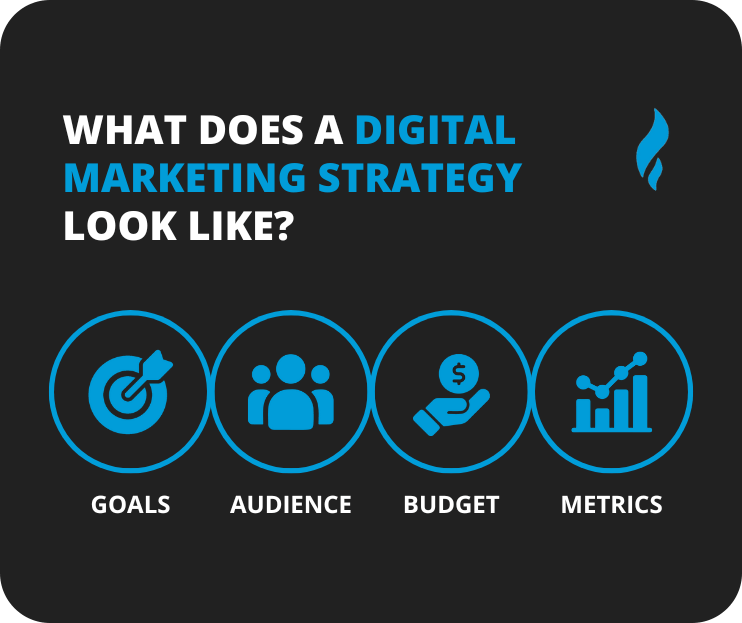
Goals
Define clear marketing goals and targets that align with the overall business objectives.
Example: Axiom Structures wanted to increase their Facebook and Instagram engagement. They 18x higher social engagement within a year by working with LYFE Marketing.
Audience
Define your ideal customer profile to create tailored messages that resonate with your target audience.
Example: University Prep Public Schools is a charter school network that wanted to target families in the South Bronx with children in grades 5–7. LYFE Marketing helped them reach 56.1k people within a month with online marketing.
Budget
Use data-driven budget allocation to invest more in high-performing digital marketing channels.
Example: Vital Vibe Health N Fitness is a wellness brand that was looking to grow their brand and increase leads. They collaborated with us and we focused their budget on Instagram and Facebook, helping them grow monthly leads by over 220%.
Metrics
You should track metrics and refine your campaigns to achieve your goals.
Example: Wrecked Angles used our social media advertising services. We helped them gain over 11M views, 100,000 new followers, and 233% content interactions growth.
Main Components Of A Digital Marketing Strategy
To execute a strategy, marketers use the right tools, channels, and methods that activate campaigns and tactics. They can turn strategies into measurable results. The main components to add in a digital marketing strategy include:
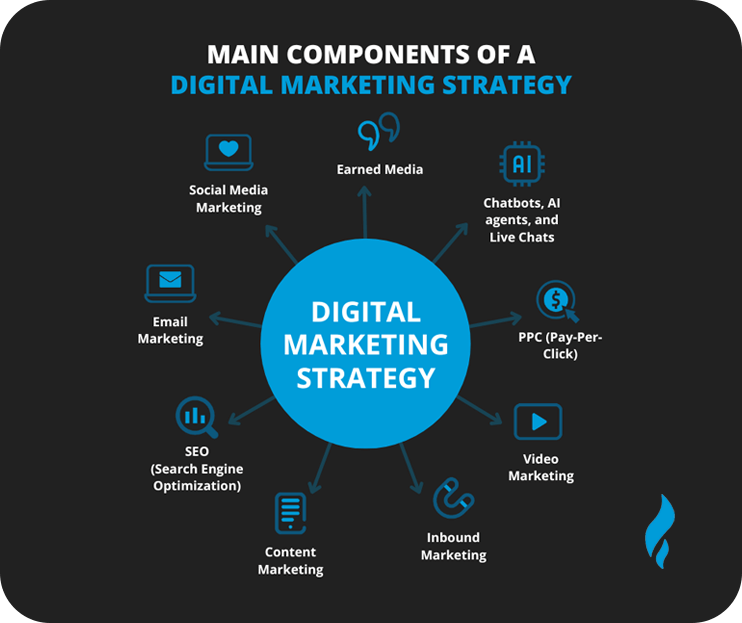
- Social media marketing
Platforms like Facebook, Instagram, TikTok, and LinkedIn can be used to engage the audience, improve your brand awareness, and drive traffic. You can use these platforms to connect with your target audiences through direct interaction and paid ads to boost your campaigns.
- SEO (Search engine optimization)
It improves your visibility on search engines and attracts the target audience. This is a free business advertising strategy you can use to build long-term traffic and brand presence for free.
- PPC (Pay-per-click) advertising
Paid ads to target customers on search engines and social platforms to generate fast traffic. They can be used to create time-sensitive campaigns around product launches.
- Email marketing
It is used to send personalized messages to your audience and build relationships, and increase conversions. This will help you retain old customers and increase sales by retargeting.
- Video marketing
This includes product demos to behind-the-scenes brand stories that capture attention and drive engagement. This can be used to build an emotional connection with the audience and promote products online.
- Inbound marketing
Inbound marketing will help you attract customers with tailored experiences. It combines tools like content, SEO, and lead nurturing to move prospects through the funnel.
Blogs, videos, and guides can establish expertise in a domain and educate your audience with helpful content. You can use it along with SEO to reach more people.
- Earned media
PR mentions, reviews, and word-of-mouth that build trust and strengthen your brand image can be used to boost campaign impact through third-party validation and organic exposure.
- Chatbots, AI agents, and live chats
They offer instant support and users through their journey to improve customer interactions. Adding these to your strategy will help nurture leads and build trust in your brand.
How These Components Fit Into Strategy Execution
Suppose the goal is to increase brand awareness. Your campaign should create thought leadership using content marketing and social media. This will include tactics like publishing blogs and sharing targeted posts to reach and engage the right audience.
How To Build A Digital Marketing Strategy
We will reveal our structured steps to create a digital marketing strategy that aligns with your business objectives and marketing goals:
1. Set Goals And Objectives
You need to define your goals and objectives that should align with the overall business targets. Use a specific, measurable, attainable, relevant, and timely (SMART) approach for your goals to stay on track.
Here is an example of the SMART approach that is used by the best online marketing agency for success:
- Goal: Increase brand awareness among small businesses looking for social media management.
- Strategy: Use social media marketing to share valuable tips, case studies, and client success stories.
- Objective: Grow social media followers by 25% first quarter.
2. Consider Buyer Personas
You should use data to build clear buyer personas to understand your audience. This will give you ideas to increase sales and guide your marketing strategy. Here is what to include:
- Demographics: Use analytics to see where your audience is active.
- Income/Job: Collect details through surveys or lead forms.
- Interests/Goals: Learn what they care about and struggle with using focus groups or research reports.
3. Audit Your Assets
Check your existing digital assets to find what’s working, what’s missing, and where you can improve. Document the details and create strategies to improve them.
Steps to take:
- Crawl your site: List all pages, including blogs and service sections.
- Spot the gaps: Identify missing content or features your audience needs.
- Check SEO performance: Use keyword data to find areas for optimization to improve visibility and traffic.
4. Plan Your Content Creation Resources
Plan how you will create and manage content because you need quality content to create effective campaigns. You should look into the following for quality content:
- Budget: Allocate a budget to spend on content and promotion.
- Resources: Decide what can be done in-house and what needs outside help.
- Tools: Make sure you have the right tools for tasks like design or project tracking.
- Deadlines: Set clear, realistic dates to stay on schedule.
5. Choose the Right KPIs
Measure what matters by picking KPIs (key performance indicators) that match your online marketing goals. These will help you track progress and improve results.
Examples of KPIs:
- Conversion rate
- Cost per lead
- CTR (Click-through rate)
- Engagement per visit
- Return visits to your site
- MQLs, SQLs, and bookings
- CLV (Customer lifetime value)
25 Top Digital Marketing Tips To Make More Money Online
Marketing to customers online is 10 times easier than using traditional marketing tactics. Online marketing is cost-effective, it’s easier to reach your audience, and you know exactly who you’re reaching. You can optimize campaigns and websites if they are not performing the way you want them to.
You can see how many people have opened your emails and clicked a link, and even target who you want to when you want to. Stop wasting time and money on traditional marketing and go digital! Let’s dig into some of the best online marketing tips.
1. Know Your Target Audience And How To Target Them
These two online marketing tips are key. If you’re not targeting the right group of people, you’re going to lose money. It’s as simple as that. You will need to aggressively research your target market or hire an online marketing company.
What are their demographics? Their buying habits? What does your typical customer look like?
After you know who to target, figure out how to target them. An easy way to do this is to build a lookalike audience on Facebook. This targets users who look like your target audience, whether it’s age, gender, interests, or other demographics.
2. Optimize your Site
Most business owners know that their websites need to be optimized in order for search engines to find them and rank them. If you don’t know, that’s okay. Learn all about how important SEO is for your business, and then you’ll be up to speed!
Optimizing your website includes making sure you have an H1 tag, a title, a meta description, relevant keywords, alt text for your images, and the appropriate amount of text. You can do this organically, or you can pay for it.
3. Use Google Ads (PPC) For Visibility
You can run advertisements on Google so that your business shows on the first page of search results. Ranking this way is instantaneous, whereas SEO takes some time before you see your site on the first page of search results.
It certainly pays off to be at the top of the page. Google Ads take up the first four positions on a search results page. Those results are the first ones people see and get the majority of clicks.
It sounds simple, but Google Ads can be complicated with all of the settings and insights it offers. But if you do it right, all of those clicks will lead to conversions.
Here’s a simple search on Google for basketball shoes. As you can see, five ads come up with the brand Adidas being number one.
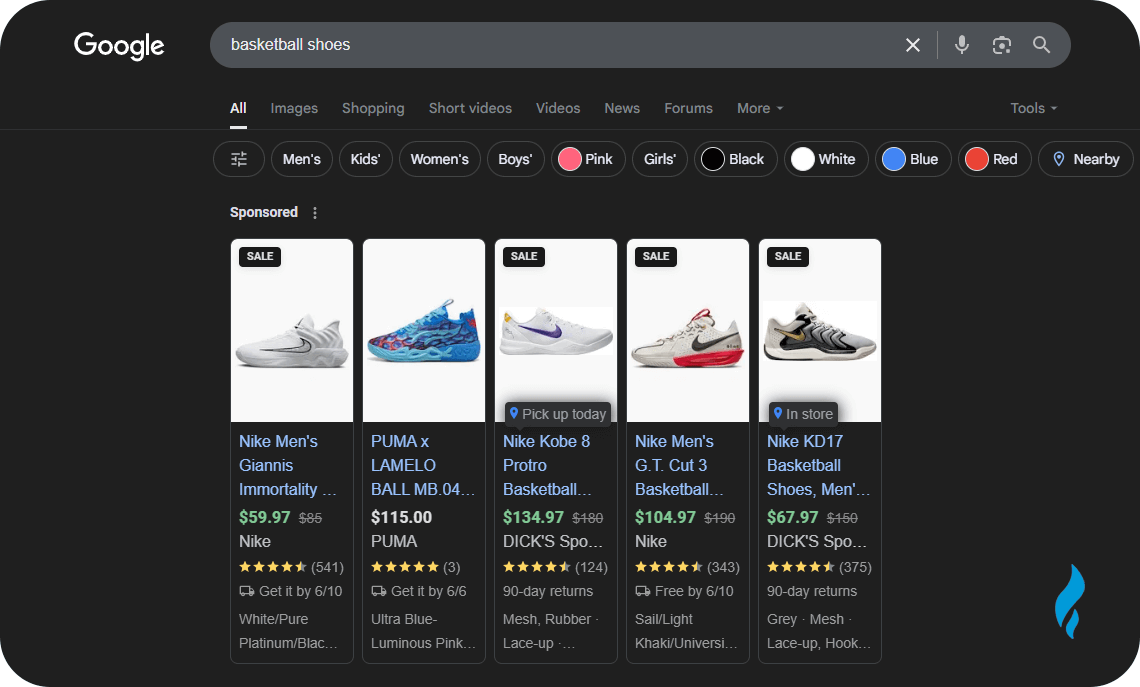
These first five positions are all targeting the keyword “basketball shoes” and paying each time their ad is clicked by a potential customer. The position of your ad is determined by several factors that give your ad a score based on the quality of your ads and how much you are willing to pay per click.
Even if other brands are competing for the same keyword, you can rank above them and pay less per click if Google sees your ads as highly relevant.
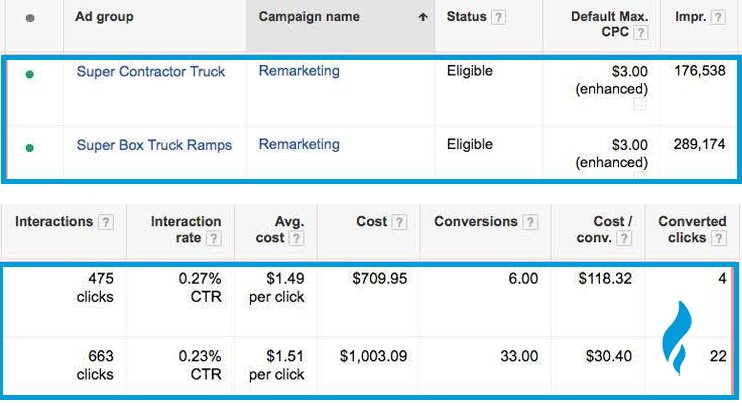
We’ve generated 7,942 clicks for this client.
4. Advertisement Congruence
If your business is running ads, this is one of our most important online marketing tips! Ad congruence is when your ads and landing pages look alike or have the same message.
Have you ever clicked on an ad and been taken to a page that looked nothing like the ad?
When your ads look like the web pages they lead to, customers will feel like they are in the right place. If your ad is radically different from the page it is linked to, customers will likely be confused and exit your site.
Let’s look at a PPC ad from LYFE Marketing for the keyword “social media agency.”
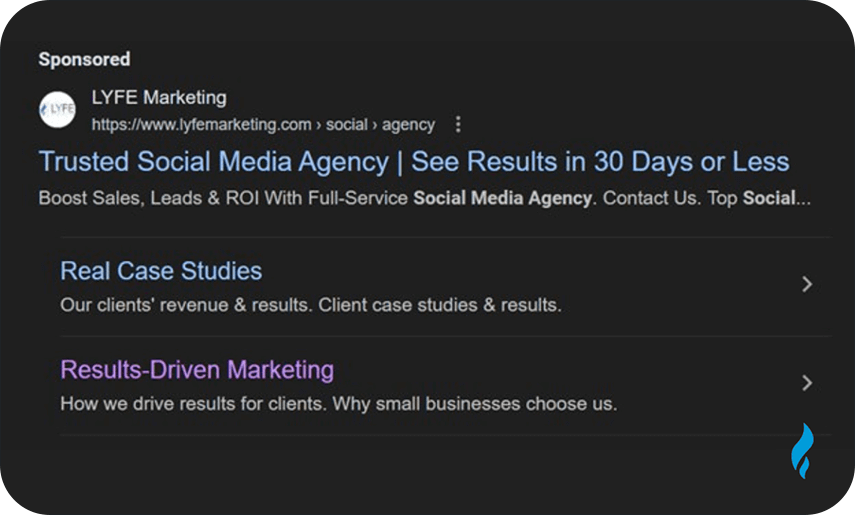
When a customer clicks on this ad, they are immediately taken to this landing page for the social media services. Both the ad and the landing page tell the customer the same or similar information.
If your ads aren’t leading to conversions, it could be because your ads don’t match their landing pages.
5. Write Blogs
A blog can help out your SEO immensely. Writing longer blogs that are full of relevant keywords and rich content triggers a response from search engines to rank your site higher.
It also adds value for your customers. If they have a question and you write a blog about it, you have just answered their question and become a reliable source for information.
You’ve created a connection before you have even met them. Nurturing website visitors is what turns leads into conversions and creates lifelong customers.
6. Get Backlinks
Backlinks can make a huge difference for your website’s SEO. A backlink is when another website links to a page on your site. When you get a backlink from a site that has a higher domain authority than you do, it sends a signal to Google that your site is credible.
This also improves your rankings. Think of it like one of your superiors at a previous job writing a recommendation letter for you. That’s how the search engines see it.
The more backlinks you have, the more likely you are to move up in search rankings!
7. Perform Internal Linking
Internal linking strengthens your website and increases your rankings. It also helps in site navigation, building page hierarchy, and distributing page authority throughout your website.
The more content you have, the better. Learn about why is content marketing important for your business.
8. Get on Google My Business
This is one of those online marketing tips that should be a given, but some businesses still don’t have a Google My Business account.
When you search for your favorite restaurant on Google, there’s a bunch of information that comes up on the right-hand side of the search results page. It displays the businesses’ address, phone number, hours of operation, photos, questions and answers, and even customer reviews.
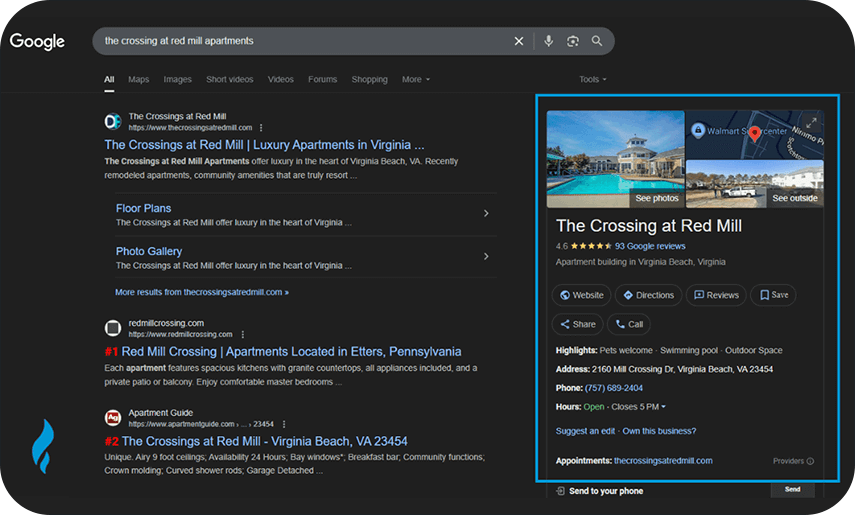
Google My Business listing allows you to stand out and can help draw purchasing customers in if you know how to get more Google reviews and optimize your profile correctly.
If you need help with ranking your website higher on search engines, get our affordable SEO services here.
9. Keep Your Content Fresh
Updating the content on your website gives search engines a reason to keep ranking your site. Having fresh and current content also keeps your potential and returning customers coming back. Search engines are constantly crawling sites.
You already know that fresh content will keep them coming back for more but stagnant content could hurt your website’s rankings. The more you change or add to your site, the better your chances of maintaining a higher search ranking.
10. Update Your Website
Not only is it important to update your content, but if your website looks like it’s from the 1990s, it’s time for a total makeover. Website design is constantly evolving, it’s important to keep up with the current trends so that you can compete in your market.
Old website designs can look spammy to customers, they will quickly leave your site and move on to one that is more aesthetically appealing.
11. Have A Cool Website Design
Engage your potential customers with web design that is up to date and exciting. Use cool features like parallax scrolling and make sure the user experience is on point.
If your website looks clean and is easy to navigate, you will be able to build trust with potential customers. If customers don’t understand how to navigate or can’t find what they’re looking for, you have just lost a sale.

Sparkle Fam came to LYFE Marketing to develop a landing page for their website.
12. Make Sure Your Website Is Responsive
What’s the point of even having a website if it doesn’t look nice on every device? 61% of users are unlikely to return to a mobile site they had trouble accessing. If your site is not responsive, potential customers will find another business.
More and more people are making purchases through mobile devices, so make sure that your website is mobile-friendly. Read this post next to learn how to make your website mobile-friendly.
13. Utilize Website Pop-ups
A pop-up on your website allows you to collect information such as email addresses from people who visit your site.
You can also use a pop-up to offer a coupon code or discount to first-time customers to further entice them to continue to your site or buy your product or service.
Combine them for the ultimate pop-up: A coupon in exchange for an email address. Popups are so helpful because once you create them, they do all the work for you.
14. Build a Presence on Social Media Platforms
If you’re not already doing this, you should be. Having a social media presence is important for growing your business and increasing engagement.
Not only should your business be on social media networks like Facebook, Instagram, or X (Twitter) these social media icons should be visible on your website. This is an easy way to potentially gain followers.
Once potential customers are following you on social media, you can then reach them with tactics like boosted posts.
15. Boost Social Posts
Organic reach on Facebook can be unpredictable. Facebook only shows your content to a very small percentage of your followers, and there’s a good chance your content will get lost in between all of the memes and Happy Birthdays.
Facebook is a pay-to-play platform. This means that in order for your content to be seen by a large audience, you have to pay for it. Boosting your posts can increase engagement and help promote your products or services. It ensures that your content is in front of your audience.
16. Use Google Analytics For Insights
If you don’t know what Google Analytics is, on a surface level, it’s an automated way to gather data on your potential customers.
It will help you answer questions like “How long are customers spending on my site?” or “Why did they get to the checkout page and not make a purchase?”
Google Analytics has the power to track every movement on your website that a customer makes. If your customers are making it to your checkout page with items in their cart, but not making a purchase.
Something is wrong, and Google Analytics will let you know.
There could be a number of reasons that people are abandoning their carts, but figuring it out on your own could cause even more problems. An online marketing expert will be able to help you solve this problem quickly and prevent it from happening again.
17. Use Email Marketing
Email marketing is important to any business, no matter how big or how small. Sending emails to your customers is a cost-effective way to market to them directly. It’s like snail mail but better.
You can include graphics and photos, and CTA (calls to action). You’ll know who opened and clicked and when! You can even track revenue. Email marketing and social media go hand in hand.
Don’t have an email list? Set up a campaign to capture emails. Already have an email list? Use it to create a lookalike audience so that you can better target potential customers. The possibilities are endless.
18. Implement Email Automation
Here are three online marketing tips in one. Email automations are, for lack of a better word, awesome. Once you create them, you can sit back, relax, and let them do their thing.
Welcome automations, abandoned cart automations, and retargeting automations are three of the best ways to reach your customers. A welcome automation greets your customers once they sign up to receive your emails.
As a business, you want to put your best foot forward, so greet your customers as soon as they give you their email. Abandoned cart and retargeting automations are both great ways to get that sale that might otherwise be lost forever.
19. Give Away Free Stuff
How are you going to make money if you’re giving away free stuff? Giving potential customers a taste of your product or service is one of the best ways to get people hooked on your brand.
Customers who receive a free product are 20% more likely to spread the word about your free product than they are about a product they paid for. By giving away your product for free, you’re essentially paying for the word-of-mouth advertising.
A great example here is Spotify. They offer a free version to customers, but also offer a free 30-day trial of premium, ad-free music.
Once their customers are hooked and see that they can get more with paid features, it’s a no-brainer to upgrade to a premium account, especially after the 30-day free trial.
20. Use Social Media To Engage With Your Customers
Customers love to engage with brands, and they love it when a brand reciprocates.
Take Wendy’s, for example, and the famous case of #NuggsForCarter. Carter Wilkerson tweeted at the major fast food chain and asked how many retweets he would have to get to receive a year of free chicken nuggets.
Wendy’s replied with 18 million.
Your brand doesn’t have to go all out like Wendy’s did, but replying to customer questions on social media platforms is a sure way to put your brand above the rest.
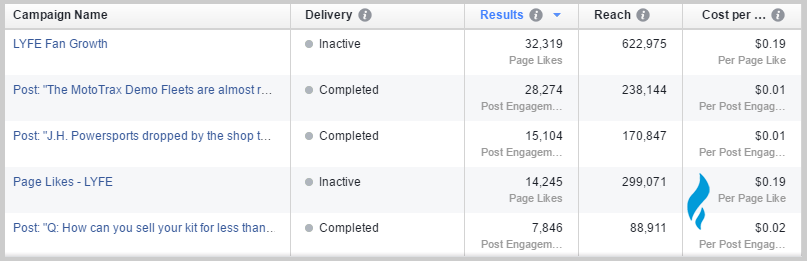
We generated 49,377 Facebook fans
21. Figure Out Which Platforms Your Business Should Be On (B2B vs B2C platforms)
If you’re a business-to-business (B2B) company, you will want to make sure you are using the best social platforms to better your relationships with other businesses. We recommend using Facebook, X (Twitter), and LinkedIn.
If you’re a business-to-consumer (B2C) company, you will want to be on all of the social platforms that your customers are using. We recommend Facebook, Instagram, TikTok, and Pinterest.
Also, using Yelp and Google as these platforms help build social proof. When your target audience is in the ‘consideration’ phase of the Customer Buying Cycle, your brand has established trust and legitimacy.
22. Utilize Videos
Use video as often as you can to showcase products and solutions. By next year (2026), video content will be king and will drive 85% of search traffic in America.
In other words, video is huge, and your business needs to have captivating video. Posting a video on a social media platform is an easy way to showcase your product and how it works.
Video ads generate more engagement and higher CTR (click-through rates) than traditional static advertisements. They also allow your potential customers to understand your product or service before they land on your site.
With videos, customers are better informed about your product or service, which leads to higher conversion rates. Here’s a full guide on how to build a custom video marketing strategy for your brand.
23. Checkout optimization
This is a major problem for eCommerce stores, so if you have one, you don’t want to miss this! Most businesses don’t even think about optimizing their checkout process.
Customers abandon their carts all the time for many reasons. They could be second-guessing their purchase, or maybe they don’t trust your website to handle their credit card information.
How do you build trust on your checkout page? How do you make your customer feel safe when they give you their credit card information? You can start by making sure your checkout page looks legitimate and secure.
Be as transparent as possible and make sure that there are no hidden fees. Customers don’t want to get all the way to the end of the checkout process only to be hit with a large shipping fee.
Make sure your checkout process is optimized from start to finish. The fewer abandoned carts, the more sales for your business!
24. Create Reputation Management Strategy
Your customers can become ambassadors for your brand if they have a good experience and share it on Google or social media sites. They can also become your worst nightmare if they leave a bad review.
It is immensely important to thank customers who leave good reviews and to communicate with customers who leave bad ones. Your reputation management strategy can humanize your business and help it grow immensely if it’s done correctly.
25. Stay Top of Mind with Remarketing
Remarketing is most important digital marketing tips because it targets potential customers who have visited your site but may not have made a purchase.
With remarketing, your ads will appear on other sites that your potential customers visit, keeping your brand name in front of their eyes even though they’re not on your website.
This reminds them of your products and services over and over again and encourages them to return to your site and make the purchase they didn’t make earlier.
Wrapping Up
Digital marketing has changed the way businesses can market to their customers. You can convert potential leads into paying customers using internet marketing.
It’s all about execution. You can set up your email automation, design your website, retarget your customers, and optimize your site with keywords, but do you have the time to do it all?
These are all excellent online marketing tips, but take the stress out of figuring out where your Facebook pixel should go on your site and let the experts at our digital marketing company help you grow your business.
Contact us to schedule a time to speak with one of our specialists to see how our online marketing agency can best support your needs.
Digital Marketing Tips FAQs
What is the best strategy for online marketing?
The best strategy for online marketing is to understand your audience and use SEO, content, and paid ads based on clear goals. Keep track of results and adjust regularly to improve performance.
What is the 3-3-3 rule in marketing?
The 3-3-3 rule in marketing focuses on 3 key messages, 3 target audiences, and 3 marketing channels. This rule helps simplify your strategy and clarifies what matters most.
What are the 4 P’s of online marketing?
The 4 P’s of online marketing are product, price, place, and promotion. You can use a combination of these to achieve your marketing objectives.
What are the 5 S’s in marketing?
The 5 S’s in marketing are sell, serve, speak, save, and sizzle. This can help your business set goals for sales, customer service, engagement, cost-efficiency, and brand impact.
Other Online Marketing Resources
- The Top 15 Online Marketing Channels
- 25 Local Online Marketing Tips for Small Business
- Digital Marketing 101: The First Steps To Becoming An Expert
- What Is Online Marketing?
- Online Marketing For Beginners: The Top Digital Marketing Tips For Small Businesses
- How To Use Internet Marketing Strategies To GROW!

