

The question we often get as a social media marketing agency is: “Does social media increase sales? The short answer is yes. But it does take the right strategy (and time) to make it work.
You can increase sales on social media. Social media advertising platforms directly influence buying decisions and play an important role in the customer journey.
People use social media to search for products and services, and if your brand is present on these social media platforms, you can increase your brand awareness and drive sales.
When someone follows your brand during this stage, it’s a sign they’re interested in buying. Best brands on social media sell directly on these platforms to make it easy for their customers to buy from them.
Here are 6 tactics you can use to increase sales on social media:
1. Sell Directly On Social Media Platforms
Use of social media platforms increased in the pandemic, but this increase wasn’t temporary. Social media trends now dictate the interests of people and, in some ways, their buying behaviours.
It’s not wrong to say social has become the new shopping mall, and the platforms and businesses are adapting to that shift.
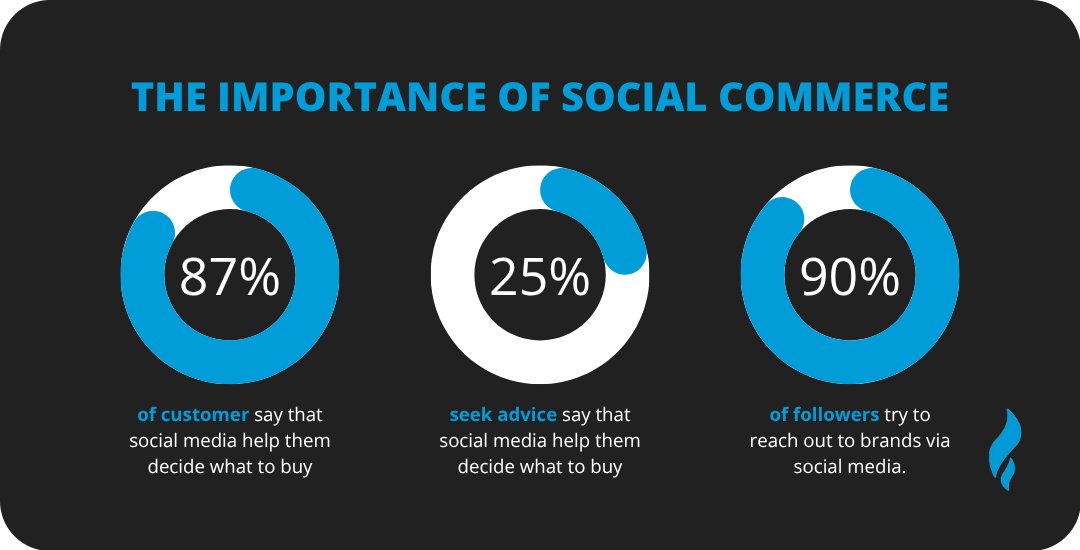
Social commerce covers the full customer journey, from discovering a product to buying it, all within the same platform. With an easy shopping experience and quick checkout, people are more likely to buy on the spot.
Platforms now offer built-in tools for selling on social media directly. Most popular platforms include:
63% of businesses are already using social commerce. You need to link your product catalog to these tools or group them into a collection to promote them in your social media campaigns.
2. Find Content That Resonates With Your Audience And Scale It
Data and social media best practices suggest that visual content performs better than text-only posts. But your audience can respond differently depending on your audience and the type of products.
You can find what works best for your audience using A/B testing and add UTM tags to track clicks and user behavior.
You should also track these social media KPIs:
- Organic: You should track engagement rate, CTR (click-through rate), social traffic to your site, and actions taken on your website (like purchases or form submissions).
- Paid: Conversion rate, ROAS (return on ad spend), and CPC (cost per conversion).
The more metrics you track, the better you will understand your audience. Once you have identified the content format that resonates with your audience, make it shopable.
Yes, you can turn anything into a shoppable item on different social media platforms. It can be a shoppable product video, user-generated content, and much more.
3. Use Conversational Commerce To Nurture Buyers
You can directly communicate with your audience on social media, and this increases your chances of sales on social media. Social media users love personalized customer service.
This doesn’t mean you’ll have to reply to each customer separately. You can use a chatbot to send automated replies to potential customers and share important updates.
The process is called conversational commerce. An example of this is you getting a discount code in your DMs. Or booking a haircut through Facebook Messenger.
This helps your business build stronger connections and offers personalized help. It also increases brand trust and loyalty.
Conversational commerce isn’t just about generating sales. It’s a way to deliver great customer service, which matters just as much.
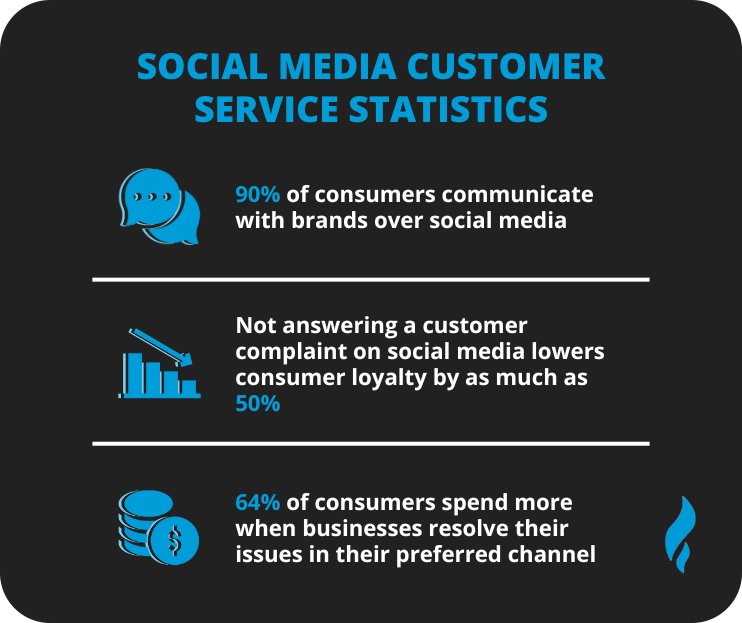
No matter where someone is in the sales funnel, you need to manage incoming messages and offer quick help. And you don’t have to worry about a chatbot handling your customer support.
Chatbots have improved and now give both your team and your customers more control. They handle common questions, so your team to focus on more complex issues.
4. Use Social Listening To Find Topics That Resonate With Your Audience
Social listening helps you track public conversations to better understand your customers, industry, and competitors. It shows what trends your audience cares about, how people feel about your campaigns, and where you can stand out.
When using social media for marketing, these insights help you make smarter decisions and stronger strategies.
Use what you learn from social listening, content performance, and customer service feedback to create successful social media campaigns that drive results.
Social listening can also help you spot sales opportunities, but you have to act fast.
For example, Hy-Vee wasn’t tagged in the original post below, but their team caught the mention through social listening and jumped in with a response.
5. Use Employee Advocacy
Increasing sales on social media isn’t just for B2C brands. B2B online marketing companies can also grow revenue by encouraging employees to promote their brand.
Employee advocacy happens when someone shares their employer’s brand on their personal social media. This builds credibility of employees as industry experts and also increases your brand awareness.
The best part is that this messaging follows a consistent brand voice, and this goes beyond your brand reputation, and it generates social media ROI.
Employee advocacy helps your employees find lead-generating content that fits their audience and share approved messages quickly.
6. Post At The Right Time On Social Media For Your Audience
You need to figure out the best time to post on social media to increase social media engagement and traffic. Here are the best times to post on different social media platforms in the US:
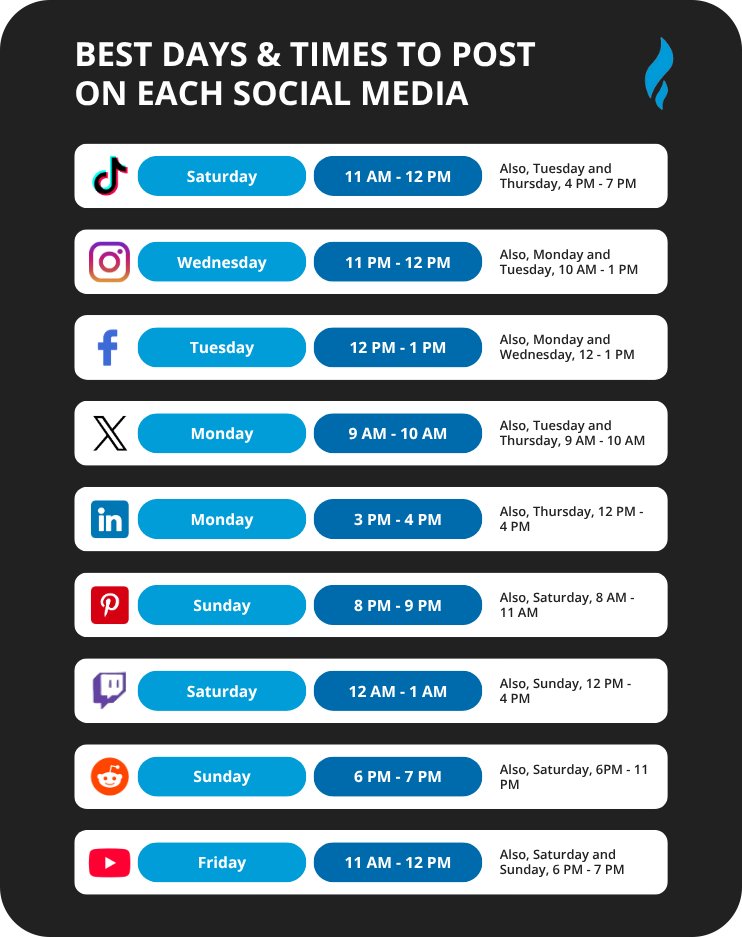
All times are according to EST
Posting at the right time increases impressions, engagement, and conversions. You should check social analytics to find the time that works best for your audience.
Here are some stats to guide you that show how important it is to post at the right time:
- Facebook: Posting at the right time, you can get 62% more impressions and 135% more engagement
- Instagram: 44% more impressions and 65% more engagement
- X (Twitter): 59% more impressions and 97% more engagement
Posting when your audience is active increases your social media traffic and chances of making a sale.
7. Use Limited-Time Promotions To Create Fear Of Missing Out
Sometimes the customers like your product, but they are not sure whether to buy right now or later. In such cases, a little push is all they need to make the final purchasing decision.
You can promote your products with limited-time offers to create a sense of urgency. The customers will buy out of fear of missing out (FOMO) on the discount.
The best part is that these limited-time offers also entice people who were not considering buying to get the discount. This will guarantee an increase in your sales.
8. Implement Analytics
All social media platforms now provide detailed insights into key metrics like customer engagement, views, reach, and much more. You can track these metrics to have an understanding of what’s working for your business.
Track analytics to get details about the audience that integrates with your posts and social media ads to run remarkable campaigns. Platforms like Facebook also provide you with the option to target a lookalike audience that resembles your customers.
9. Build An Archive Of Your Presence
Smart buyers take their time to research before they trust your brand. A long-term social media strategy can help you turn them into customers. They scroll through your past posts and interactions to see if your brand is worth it.
User-generated content on your social media can help build trust and show real customer experiences. You should keep your posts consistent and promote a clear, helpful tone.
Stay active in relevant groups and engage with the audience who shows interest.
10. Stay Engaged With Existing Customers
One way to increase sales is to keep your existing customers engaged using your social media profiles. This will help you convert them into repeat customers.
You can keep them engaged with personalized messages and share offers to show them you value them. This also builds brand loyalty and encourages them to recommend your brand to others.
How To Increase Sales On Social Media: Case Studies
LYFE Marketing has helped small businesses generate $304 million in revenue with social media advertising services. We will share the exact process we use when creating a social media sales strategy.
But to prove our strategies work, we have attached screenshots & results for our client campaigns. Watch the short video below for a brief overview of the results, and read on for the full, in-depth case studies.
Case Study 1: We Used Social Media To Increase Sales by 714% For An Online Brand
LYFE received this email from the owner of an eCommerce candle company, Easy Diya. The email said: “I’m interested in learning about your digital marketing solutions.”
We’re always thrilled to help another small business grow, so we jumped at the opportunity. Once she agreed to the terms and our management fee, our process began.
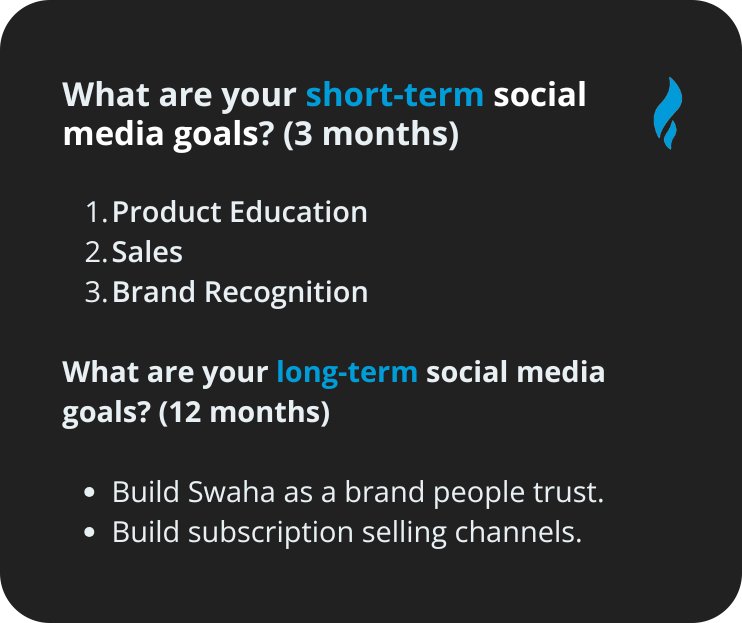
The first step in our process is for our client to complete a social media questionnaire. The questionnaire is composed of about 20 questions. This helps our team develop a strong understanding of our client.
While all questions are important, two critical ones help us develop a strategy.
- What are your short-term goals? (3 months)
- What are your long-term goals? (12 months)
For this client, it was simple. They wanted people to understand their product and buy it.
We use this simple formula when it comes to using social media for sales:
Social Media Drives Sales When = Product is Great + Target Audience is Reached + Content is Engaging
Now let’s break this down a bit further. Starting with, how do you know if you have a great product?
Start by asking yourself these questions:
- Does the product solve a problem (better)?
- Does the product offer an extreme benefit?
- Does the product have a big market?
- Can the product be explained easily? (1-2 sentences)
They had a really great product. Their product gives people an easy way to burn pure ghee wick (completely organic) for meditation/prayer.
Here’s a video example of the problem they solve:
It was up to our team to create engaging content. Then reach the right audience. Our team went the extra mile to develop a completely measurable sales-driven campaign.
Take a look at this screenshot below from their campaign.

Here are the results:
- Period: October 1, 2016 – November 1, 2016 (30 days)
- Reach: 63,884
- Clicks: 2,745
- Cost Per Click: $.19
- Click Through Rate: 2.32%
- Number of Purchases/Sales: 152
- Cost Per Purchase/Sale: $3.42
- Purchase Conversion Value: $1,557.50 (This is the revenue generated strictly from our ad campaign)
Through Facebook’s pixel, we tracked everything that truly matters. From the CPC (cost per sale) to the total revenue.
Here is the performance of sales over a 3-month period from September to November.

As you can see, when we optimized our Facebook ad campaign on October 1st, there was a huge increase in sales.
It can take multiple A/B split tests of audience and ads before finding the winning combinations. On average, it takes our team roughly 3-6 months to find the sweet spot.
Case Study 2: Social Media Sales Strategy For A High-Dollar Product
The impact of social media on sales has nothing to do with keeping your social media channels updated with posts. Instead, social media marketing increases sales when:
You create engaging content. You reach the right audience. But what steps are necessary to do this as quickly as possible and most cost-effectively?
The answer: A proven social media advertising strategy.
At LYFE Marketing, we have tried and tested hundreds of social media tactics.
Learning from mistakes and having enough historical data to understand what works, we can develop proven social media strategies that focus on marketing objectives that matter.
A big part of a social media sales strategy is using sponsored ads on Facebook, Instagram, and other social media channels.
If you are curious about how we generate social media sales for a product that sells for over $500, take a look at the screenshot below from one of our clients selling used DSLR cameras:

Facebook Retargeting campaigns:
- Period: July 11, 2016 – July 14, 2016 (3 days!!)
- Reach: 17,311
- Purchase: 14
- Amount Spent: $968.08
- Purchase Value: $6,785.97
- Cost Per Purchase: $69.15
See how we aren’t tracking the number of total fans or engagement levels, but the main KPIs. We are tracking numbers that really impact a business’s success or failure
But the first step towards generating these types of results is putting together a plan of attack
Case Study 3: Increasing Sales Through Social Media for T-Shirts
So far, you’ve seen how we helped increase sales for two unique small businesses. Lastly, take a look at how we helped a company in a very competitive space with a commodity product, t-shirts.
Prior to signing on with LYFE, our client generated literally ZERO online sales. Take a look at the screenshot below.
You will find no sales from December 1, 2016 – December 28, 2016
See the spike from December 29, 2016 – January 31, 2017 that’s us at work.

In only 1 month, our client saw a lift of $3,426.62 in online sales (from zero before).
Even better, they got nearly an initial 3x return on their marketing investment, with an ad budget of only $30/day.

Take a look:
Results (transcribed):
- Period: December 31, 2016 – January 31, 2017
- Reach: 158,668
- Purchase: 103
- Amount Spent: $1,147.44
- Purchase Value: $2,943.91
- Cost Per Purchase: $11.14
Again, we are not tracking fans or engagement, but what matters most to our clients: Sales and Cost.
These are just their initial costs to acquire a customer. On average, their customers return and make repeat purchases 4x a year. Meaning the lifetime value of their customer is around $114. Bringing the ROI to over 10x return! Who wouldn’t like to spend $1,000 and make $10,000?
Here’s 1 of 20 different ads we made that contributed to their success.

Sounds good to you? That’s our pitch. If you’re looking for a turnkey solution and a team dedicated to helping you increase sales through social media. We can help.
But if you are looking for sales to explode overnight or even within the next 60 days, then we’re not for you. Increasing sales through social media takes time and a commitment to the strategy.
If that all sounds good and you’re ready to get started, then follow these next steps:
- Go to our contact page
- Fill out all the basic information
- Shortly after, you will be prompted to schedule an appointment, pick a time/date that works for you
- Show up for your “get to know you” call with one of our sales consultants.
Our Proven Social Media Sales Strategy
Here is our social media sales strategy:
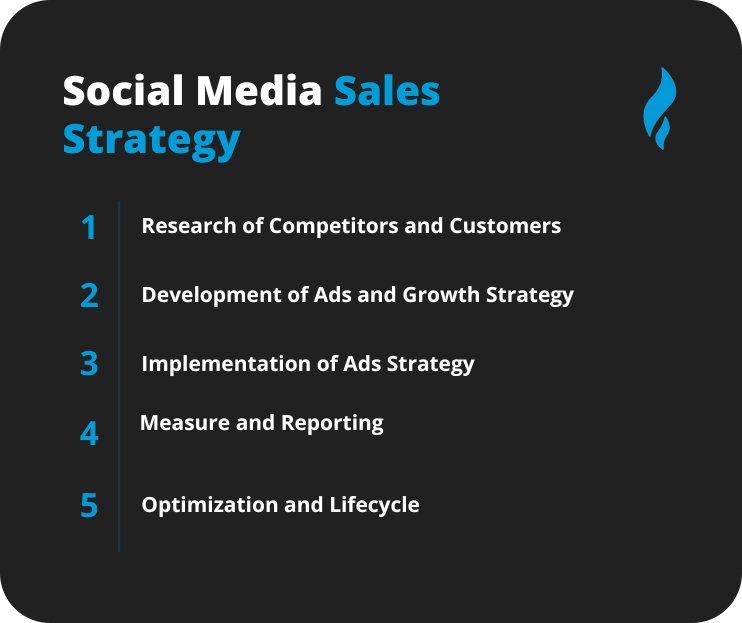
Phase 1: Research of Competitors and Customers
Phase 2: Development of Ads and Growth Strategy
Phase 3: Implementation of Ads Strategy
Phase 4: Measurement and Reporting
Phase 5: Optimization Lifecycle
We are revealing to the public details on each phase of our strategy. But why? We want to showcase what truly makes us different and answer our questions of our prospects’ on how we work.
For true transparency, we want to show you exactly how our company can help you grow. Let’s jump right in:
Phase 1: Research Of Competitors And Customers
More than likely, at this stage, your competitors (primary or secondary) are already on social media. Learn from them before you start.
What is working for them? What is not?
The first thing we do is a competitor analysis. We break down exactly what social channel they’re on, what content is resonating, what the weaknesses are, and the total fan base.
Next, we move into researching your ideal customer. This is done by developing a customer avatar. A simple, yet very powerful analysis.
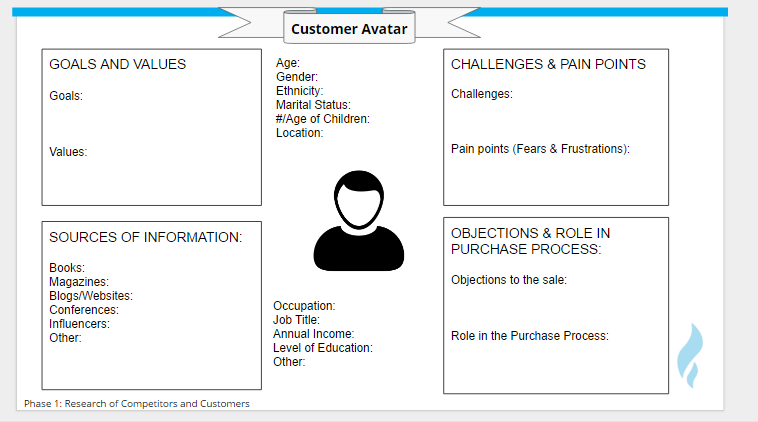
Within a customer avatar, we break down who your ideal customer is by age, gender, location, marital status, job title, level of education, and income.
These characteristics are all possible within Facebook and Instagram ad targeting options. There are 4 key elements of a customer avatar.
- Goals and values: What does the customer want for himself? Family? Friends?
- Pain points and challenges: What is the customer frustrated with? What prevents the customer from reaching their goals?
- Sources of information: This is info about where your ideal customer is hanging out online. What blogs are they reading? What conferences do they attend?
- Objections to the sale: Why would the target audience say no to your product? Is it time? Cost? Difficulty using? Lack of perceived value?
The customer avatar is a critical step in our process because it helps us narrow down who exactly we will target and what engaging content to create based on the goals/pain points.
Creating a customer avatar requires some critical thinking and very accurate research. We have a systematic approach to developing our avatars, which we will uncover on our blog.
Phase 2: Development Of Ads And Growth Strategy
Now that we have research, it’s time to start the campaign, right? Wrong. It is time to take that research and turn it into an actionable strategy.
When drawing up a social media strategy, it’s important to keep your primary short-term goals and long-term goals at the forefront. You’ve probably heard of all the benefits of social media, like:
- Brand awareness
- Customer engagement
- Building an email list
- More targeted
- Generating leads
- Driving sales
- Establishing credibility
- Brand Loyalty
Read our guide on 75 benefits of social media for more information.
This means the strategy can vary based on hundreds of factors such as your goals, audience, budget, resources available (email list, existing customer base, partnerships), and more.
Here are just a few of many things we try to answer when developing a social media sales strategy:
What type of engaging content will we create?
What methods will we use to acquire fans/followers?
What will advertising funnels look like?
What lead magnets or giveaways can we employ?
What will we do to get website visitors and engage them?
While we can’t disclose our client’s exact strategy, you will soon see how our strategy led to predictable, recurring online sales fast.
Phase 3: Implementation Of Ads Strategy
This step is also the third step in our company process. This is where LYFE Marketing takes over and implements your strategy. In this phase, we develop a timeline for execution, set benchmarks, and do the work.
Our clients love having the peace of mind of knowing the marketing is working and having the time to focus on building their business. Sit back and relax while our team helps the business grow.
Phase 4: Measurement and Reporting (THE RESULTS)
There are two things traditional marketing and bad marketers have in common. Both are terrible at measuring return on investment (ROI).
But the truth is, measuring ROI is hard. There are tons of technical tasks to perform to properly track a campaign. A big part of figuring out how to use social media to increase sales is setting up tracking the right way.
Phase 5: Optimization Lifecycle
This is the most overlooked, but a valuable step in the process. Here we critically think about the results generated and what we should do to improve.
We uncover ways to decrease cost by breaking down what audience is responding the best or which ads work best. We also try to discover the best way to scale the campaign up to increase sales.
We usually do this when there is clear ROI and it’s time to increase the budget or audience size. We take the optimization lifecycle as a baby trying to walk for the first time.
It takes a good amount of time to get results, but after a few tests, you will be able to see a clear ROI.
How To Increase Sales On Social Media FAQs
How to improve your social media sales?
Here are 7 ways to improve your social media sales:
- Use social platforms where your audience spends time
- Partner with social media influencers
- Encourage loyal customers to advocate for your brand
- Share UGC (user-generated content)
- Create helpful content that informs and attracts your audience
- Invest in social media ads
What is the 5 5 5 rule on social media?
The 5-5-5 rule is a social media strategy where you spend 5 minutes engaging with 5 users on a platform, then repeat on another. This helps you boost engagement and build relationships.
What is the 50/30/20 rule for social media?
The 50/30/20 rule for social media suggests 50% of your posts should be engaging, 30% informative, and 20% promotional. You can use it to balance your content strategy.
What is the 70/20/10 rule for social media?
The 70/20/10 rule for social media says that 70% of your content should be educational, 20% should be engaging, while 10% should be promotional. It is a guiding principle you can use for your content marketing strategy.
