



Over 93% of website traffic today comes in through search engines. And yet 75% of searchers don’t get past the first page in search results?
To get this traffic to your website, you need a keyword strategy that has you appearing in the right searches high enough that you earn a click.
Without a strategy, a small business can waste a lot of money on SEO and paid advertising without seeing the return on their investment.
But when you build a solid keyword strategy, you get measurable and lasting SEO results.
That’s what this article is all about. Let’s take look.
What Is A Keyword Strategy?
Building your strategy is more than just doing some keyword research.
It has a lot more to do with your business and consumer behavior than search engine algorithms.
A keyword strategy is composed of several distinct elements, all of which you’ll need to see your small business boom through the right strategy.
- Who’s my target audience?
- What are my goals?
- What branding message do I want to send?
- Where are customers in the buyer’s Journey?
- What’s the competition doing / How can I do it better?
- What tools/human resources do I need?
- How do I Increase keyword-landing page relevance?
- What do I measure to know I’m on track?
- How can I optimize to maximize my ROI
We’ll look at each of these as we build a strategy together.
9 Elements Of A Successful Keyword Strategy
1. Know Your Target Audience
Build your keyword strategy around your target audience above all. It doesn’t matter how much traffic another phrase may receive.
Ignore another keyword’s click-through rate is if it attracts the wrong audience.
Start by building customer personas that outline things like:
- Demographics
- Goals
- Challenges
- Interests
- Where they spend time online/ offline
- What sources they trust
- Education level
- Cultural/Language references
A small business should have at least 5-10 distinct personas to target.
Build content around these personas along with the related keyword strategy for that content.

When you focus on a specific persona, you use keywords that are very relevant to your target.
If you’re a medical job placement service, then a phrase like “find nursing jobs” will likely be very relevant to your “Nurse” persona.
If you choose to segment your nurse audience into more specialized personas, then “Nursing jobs in Endocrinology” is even more relevant.
This same keyword is much less relevant to a physician seeking job placement services.
Even if they are an Endocrinologist, they wouldn’t search for or click on a keyword that targets nurses.
It doesn’t seem relevant to them.
Know who your target is. Make sure you’re speaking directly to that audience to earn not only a click.
Earn a click that you can convert to revenues for your business.

2. Set Clear Goals
You have overarching goals like:
- Generate brand awareness
- Increase revenues
- Cut costs
- Grow your business
But to create an effective keyword strategy, think more incrementally. What goals or objectives do you need to reach to obtain them?
Make these SMART Goals to get results.
That’s Specific, Measurable, Attainable, Relevant, Time-bound.

As you build keyword strategies, have a goal in place so that you can effectively align keywords with those goals.
Make It Specific
A vague goal can’t be measured. Even if you’re unsure about what you’re capable of, put a goal in place.
If you overwhelmingly exceed it, you know you need to set your sites higher next time.
If you fall miserably short, the goal may not have been attainable. Find out why.
Or you may simply not have had the right strategies behind it.
If needed ask some questions to make sure your goal is specific.
- When? By X date
- Where? On your website
- How? Using a specific keyword strategy
- What? To accomplish X
- With Whom? With the customer you targeted
Make it Measurable
Using analytical tools, you should be able to measure in numbers whether or not you achieved that goal.
Make It Attainable
Setting unattainable goals does no one any good. We get it. You want to reach for the stars.
But you’ll go further being a little shorter-sighted. Set incremental goals that build the path brick by brick to where you want to be.
Make it Relevant
The goal should be relevant to your business and its overarching goals. If it isn’t it’s a waste of time.
Make It Timebound
A goal isn’t smart if you don’t have a specific date to have it done. Your team has no sense of urgency to complete it.
You can evaluate whether your strategy is working.
Using SMART Goals in Your Keyword Strategy
Let’s put it all together with some examples. Note how each of these gets us closer to an ultimate goal.
- I will use this keyword strategy to increase organic impressions by 50% by July 15.
- I will use this strategy to increase the number of non-branded search traffic by 15% by August 15.
- I will use this strategy to increase leads among culinary professionals by 25% by Dec 1.
- I will use this strategy to increase sales in the anti-microbial cutting board category in my store by 500% by Jan 1.
Once you’ve established SMART goals like these, you can begin to build a list of keywords that support that specific goal.
3. Be Clear on Your Message
Who are you as a company? How would people describe your company?
What sets you apart from the competition? What do you value? What’s your company’s vision for the future?
What does your ideal customer look like?
All of these questions must be answered to be clear on the message you want to send out online. This will influence how you choose keywords.
If you’re a designer brand, having words like the following would not only send mixed messages. They could harm the viability of your brand:
- Discount
- Blowout
- Outlet

If part of your brand message is sustainability, words like these can help your brand:
- Eco-friendly
- Composting
- Energy Star
- Fair Trade
- Locally grown
Always consider how the keywords you use — or don’t use — reflect your brand message.
4. Do a Competitor Analysis
A competitor analysis serves several important functions.
- It takes inventory of your competition.
- It saves you the time you might otherwise spend “recreating the wheel”. See what’s working and what isn’t for the competitor first.
- It directs your own path. You now know what you need to do to surpass the competition.
You can waste a lot of time, money, and even misery spinning your wheels and never gain traction.
Or you get hyper-focused on what you need to do to connect with a target audience better than the competition.

It’s important to look beyond your industry during a competitor analysis to:
- Get a more accurate picture of who you have to compete with. In SEO, it’s any website that ranks higher than yours for keywords you target. In PPC campaign, it’s the companies that are using your keywords. On social media, it’s profiles that compete for your target customer’s time.
- It sparks creativity. Some of the most powerful ideas come from one industry adapting an idea used by another industry.
- It broadens your concept of products or services.
For example, you sell home entertainment speaker systems. You think you know your target. It’s young professionals with some disposable income.
As you see who’s in the space, you realize there’s a whole new persona you hadn’t considered.
You could build a keyword strategy around how your speakers integrate with hearing aids to assist those with hearing loss.
This would open you up to a fast-growing market and maybe something you want to consider if it doesn’t conflict too much with your “young professionals” branding.
How to Do a Keyword Competitor Analysis
The most time- and cost-effective way to do a competitor analysis is with advanced analytics tools like SpyFu and AHrefs.
- Start with the list of words you’re already targeting. If you don’t have one, no problem. We’ll discuss building this list in the “Build Your Keyword List” below.
- Pull the words up in a Google search. If you’re a local business, leave Google’s local search option on. If you’re eComm or a national services company, turn local search off.
- Copy the URLs (web addresses) of the top 3 websites. Do this for each keyword you want to research.
- Enter those addresses into an analytics tool of your choice.
- Find out their website authority. This is an estimate of how authoritative Google thinks their site is. To compete with them, you’ll need to put a keyword strategy that raises your website’s authority as well.
- Find out what their top-performing pages are.
- Find out what keywords they’re targeting.
- Review their top-performing content to better understand what kind of content you need to compete with them.
Make note of things like:
- Content length
- Topics covered
- Multi-media
- How they are applying their keyword strategy
- Publishing frequency
Here’s an overview of what a keyword competitor analysis might look like. Here, they have searched a t-shirt company.

Learn more about what your own strategy should look like. These tools are geared toward SEO.
But they can be used to learn more about competitor strategies for PPC and social media marketing as well.
If you don’t have access to tools like these because they’ve cost-prohibitive, complete this manually. It will take more time. But don’t do it.
One of the great things about working with a digital marketing company is that they can spread the cost of these tools across their many clients, making them much more financially sensible.
Follow the same basic steps to do this manually. Use a free keyword density tool to see what words a specific page is targeting.
Find out the authority of a website by using Moz’s free website explorer tool. Explore the content on the site manually to learn more about what they do.
Ongoing Competitor Analysis
Some say communication is the key to success in business and in life. We don’t disagree. But adaptation runs a close second.
A keyword strategy will stagnate if you’re not continually tracking how the competitive landscape is changing.
You can use analytics tools to:
- Directly monitor how certain competitors are performing.
- See whose rising or falling in rank for keywords you’re targeting.
- Watch your own rank in Google rise and fall for specific keywords.
In most cases, if your rank is falling, someone is stepping in to take your spot.
Reduced traffic and conversion, as well as increased advertising costs, will follow if it goes unaddressed.
Stay a step ahead of your competition by monitoring what they’re up to.
5. Align Keywords to the Buyer’s Journey
Each potential customer goes through a buyer’s journey. It includes 4 crucial steps.
- Awareness
- Consideration
- Decision-Making
- Delight
That last one turns customers into loyal customers and priceless promoters of your brand. Yes, you’ll use keyword strategies to do that too!

In each step, your goal is to meet people in that stage and further their journey into the next step.
Awareness Keywords
Awareness keywords meet someone who isn’t aware of a challenge, product, or brand. The content then leads then toward the consideration phase.
Some awareness keywords for a dentist might include:
- Toothache causes
- How to prevent gum disease
- Safe teeth whitening
- Best dentists in Atlanta
Consideration Keywords
Meet someone who is considering options. Lead them toward making a decision. You might do that will keywords like:
- Dentures or dental implants
- Treating gum disease
- Teeth whitening kits
- Best denture dentist
- How much do dentures cost
Note the subtle differences. Each of these suggests that the person is more aware of the problem. They’re evaluating best solutions.
Your consideration keywords may also include words that encourage a person to by now like:
- Teeth whitening discounts
- Financing for braces
Decision-Making
In this stage, people are ready to buy now. High intention keywords reflect that.
- Schedule a teeth cleaning
- Buy teeth whitening kit
- Where to get Biohorizon dental implants
Create a high intention landing page that makes it easy for this person to schedule or buy now and you can convert this traffic easily.
We’ll discuss how to do that in the “landing page” section below.
6. Getting Your Tools and Talent In Place
Planning a keyword strategy is one thing. Executing it consistently and successfully is something else entirely. This takes people and tools.
Consider the tools and work hours needed to execute the strategy effectively. Budget for each of these areas to be successful.
This includes at it’s very basic:
- Research
- Planning
- Content creation
- Content publishing
- Content distribution
- Content maintenance
- Website design and maintenance
- Analytics
Part of building a strategy is knowing who is responsible for what and how you’ll get it done.
7. Build Your Keyword List
At this point, it’s time to start applying for our prep work above to build a list of keywords for a website.
The words you choose here should build on the areas we’ve discussed:
- Target
- Goals & Objectives
- Message / Branding
- Buyer’s Journey
- Competitor Landscape
Each word you add to your list should align with these 5 elements. You can find many free keyword planners online.
Or you can use paid tools like the ones already mentioned. They give you greater insights with less work.
Moz Keyword Explorer is a great free tool.
It tells you:
- How much traffic a word gets
- What percentage of clicks are from the organic search results
- How difficult it is to compete for this keyword
- Similar keywords to consider
- Top national competitors for that keyword
- The estimated authority of the top competitors
Let’s walk through an example to see what makes a great keyword?
You’re an HVAC company. Is “air conditioner repair” is a good keyword to target?

The volume for this keyword is high. That’s a check in the pro column.
The difficulty is 38 out of 100. This number describes how easy it is for a quality site to move up in the ranks.
In other words, low difficulty means that a great site could come in a blow everyone else out of the water.
Your website may or may not be that amazing site right now. But that’s why we’re here.
To really understand how hard it will be to get onto page 1 in Google searches, look at the DA (domain authority) for the top 3 sites.
Compare this to your own domain authority. You can check your domain authority in another free tool, Moz Site Explorer.
If their DA’s are much higher than yours, it will be harder to compete with them. But that doesn’t mean you disregard this keyword entirely.
You just need to gain some leverage.
You’ll do this by doing two things.
First, choose a long tail keyword that includes this keyword as your keyword to target. That might be:
- Air conditioner repair costs
- Air conditioner repair near me
- Troubleshooting air conditioner repair
Doing so allows you to begin building your authority for that keyword without just sitting there waiting for your authority to go up. That never works.
Second, use LSI keywords. LSI (latent semantic indexing) is a complicated way to say, use other words that support your keyword.
When you do, it makes your content appear more in-depth.
Strategies like this allow this to happen.

This is a screenshot from Google search results. It looks a little different because we’re using a free plugin called MozBar.
It’s available for the Chrome browser and very helpful for competitor analysis.
Notice the DA of the top 3 organic results. A website with a 21 DA has the #1 spot.
Websites with a higher estimated authority of 94 and 86 DA should be able to beat that 21 DA. But they sit in second and third positions.
Building the right content around your keywords can make this happen.
Let’s go there next as we continue to look at actionable steps to apply a keyword strategy to your website.
8. Align Landing Pages with Keywords
We’re using landing pages here very loosely. Any page a person lands on when they click on a search result is a landing page.
It may not hold the same prestige as a Google Ads landing page that earns high conversions.
But it’s role of generating awareness and trust while furthering the buyer’s journey is equally important.
This might be a sales page, pricing page, or blog article.
In whichever case, what they see on that page influences their interaction with your site and brand. Make it appear instantly relevant.
Otherwise, you might see these scenarios.
The person used a high intention keyword. They’re ready to buy.
you greet them with exhaustive information for consideration before you get to the CTA. You may lose them.
A searcher enters a search query that included the word “sale”. The page they are taken to after clicking does not take them to a products page. They leave.
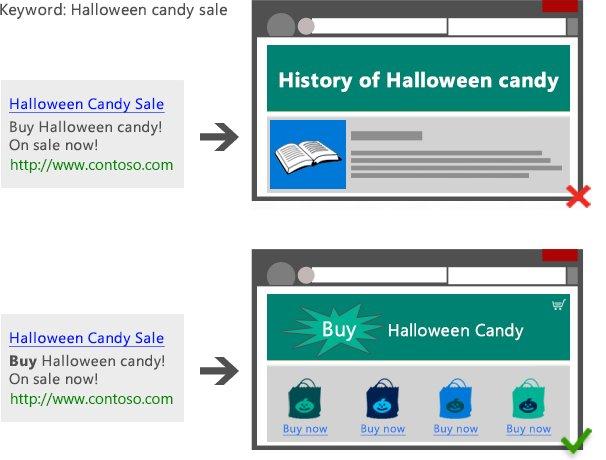
Not only did you miss out on a potential conversion. These instant departures add up.
Search engines like Google track this “back button escapes”. In their eyes, you’re not providing a great user experience.
It’s not because your site is slow or not mobile-friendly.
It’s because you encouraged someone to click on your webpage only to lead them to a page that isn’t what they expected.
The result will be reduced visibility in searches, both organic and ads. If it continues you may even become invisible in searches for that keyword.
The impact is far-reaching as this can impact the overall trustworthiness of your website. If Google sees you as untrustworthy, it will be harder to rank on any keywords.
Make sure all images, topics, language, and text continue that visitor’s journey. A person should instantly know they’ve clicked the right link.
The page should align with their:
- Persona
- Where the customer is in the buyer’s journey
- Your business goals for that content
The page should encourage them to linger in order to learn more about your brand. Or it should get them to click on other things on your website.
This makes you appear highly relevant and deserving of premium visibility in search results.
9. Track Performance & Optimize for Results
Don’t forget that your keyword strategy should keep up with your content strategy.
And since content needs to be updated regularly, you also should track your keyword performance to better improve your keyword list.
Update the keywords that you use if you find that they are low in conversions. Or maybe add a few more long tail keywords in your existing content.
No keyword strategy is complete until you have a system in place to track performance. Know what you need to measure and how you’ll measure it.
As you measure your results, you find that some keywords and content perform better than others. Study these to learn more about why they perform so well.
Make more like them.
What to Measure
At first, it may be difficult to analyze every metric you need to. But don’t let this stop you from measuring what you can.
As you learn more about applying your strategy, you’ll be able to expand the measures on your track.
In the process, you’ll set new smart goals that will help you know if you, your team, and your business are on track.
Here are some key questions that data will answer for you. In most cases, these can be tracked in either Google Analytics (GA) or Google Search Console (GSC) Both are free.
Are you being seen? Track unique visitors, sessions, page views, etc. (GA)
Are your keywords and the associated landing pages relevant and high quality? And you are attracting the intended audience? Track bounce rate, duration, and a number of pages visited. (GA)
Are your keywords and the associated landing pages leading to conversions? Track conversion rate.
Map pathways through your site to find out where people may be getting stuck.
It may be your checkout process or contact form rather than your keywords reducing the conversion rate. (GA)
Is your keyword strategy improving your rankings for targeted words in search results?
Use a tool like ProRankTracker or Serpbook, which have free versions available.
Tools like these track your position in search results each day so you always know how visible your website is for a specific keyword.

Which keywords are driving traffic to your website? Which keywords are causing impressions without a click? View this in the Search Console.
What pages are getting the most traffic? View this in Google Analytics.
Get Strategic to Get Results
Implementing SEO tactics without a clear strategy will doom you to failure. Instead, help your small business boom with the right strategy.
Know who your customers are. Be clear about your goals. Know how to gain leverage with keywords.
Align your content with your keywords to accomplish your goals
Are you struggling to implement a keywords strategy that works? Find out how we can help you grow your business with the right strategies. Contact us today.

